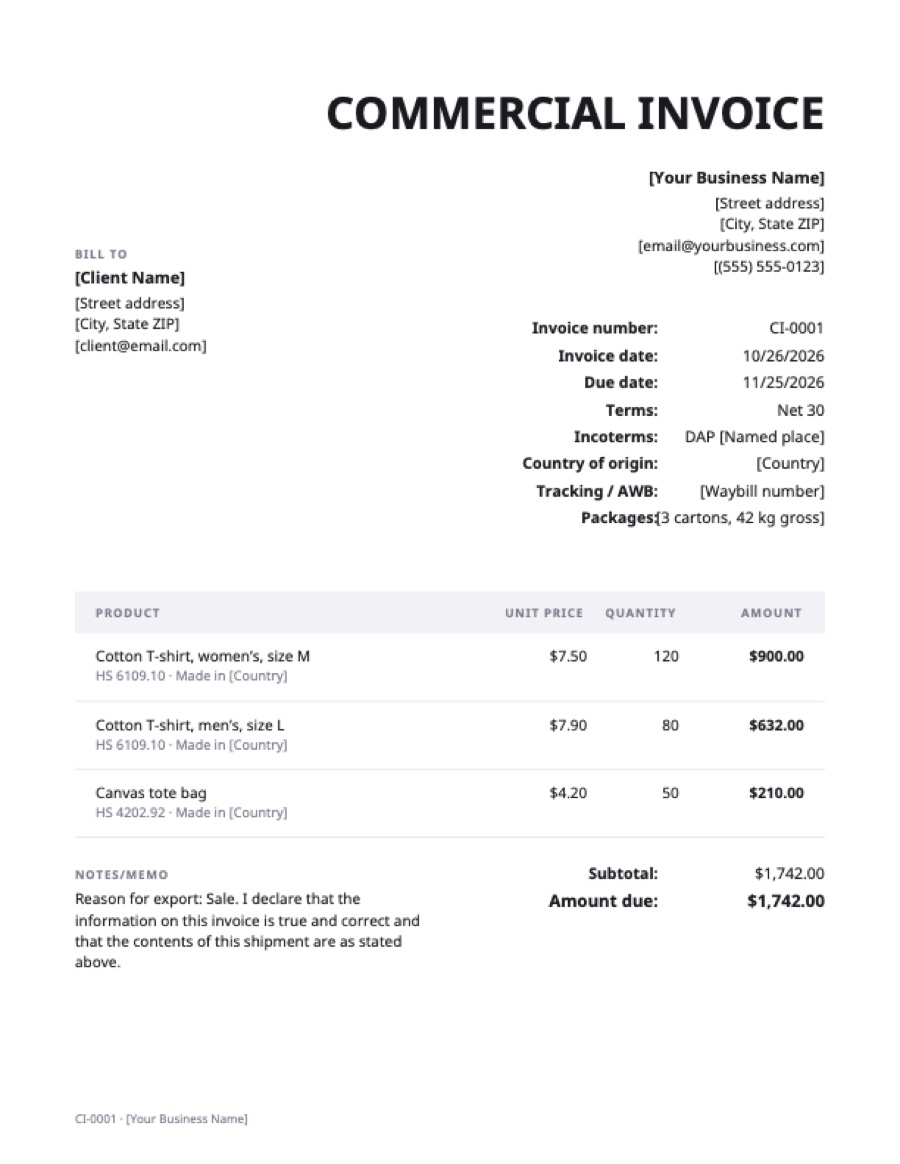
What’s on the commercial invoice template
Extra fields on this template: Incoterms, Country of origin, Tracking / AWB, Packages.
| Product | Qty | Rate | Amount |
|---|---|---|---|
| Cotton T-shirt, women’s, size MHS 6109.10 · Made in [Country] | 120 | $7.50 | $900.00 |
| Cotton T-shirt, men’s, size LHS 6109.10 · Made in [Country] | 80 | $7.90 | $632.00 |
| Canvas tote bagHS 4202.92 · Made in [Country] | 50 | $4.20 | $210.00 |
| Total | $1,742.00 | ||
Example prices in US dollars. Replace them with your own; in the generator, any currency works.
What customs needs to see
- Shipper (exporter) and consignee (importer) with full addresses, and tax or EORI numbers where required.
- Invoice number and date, and the carrier’s tracking or waybill number.
- A clear description of each item: what it is, what it’s made of and what it’s for. “Clothing” is too vague; “Women’s cotton knitted T-shirts” isn’t.
- HS code (Harmonized System tariff code) for each item.
- Country of origin of the goods (where they were made, not shipped from).
- Quantity, unit value and total value, in a stated currency.
- Incoterms and the named place.
- Number of packages and weights.
- Reason for export (sale, sample, repair, return) and a signed declaration.
Tips to avoid customs delays
- Value goods truthfully. Undervaluing to save the buyer duty is illegal and a common cause of seizures.
- Use the same descriptions and values as on the packing list and the carrier’s paperwork.
- Print and sign copies. Carriers usually want two or three copies attached to the shipment, or uploaded electronically.
- Check the destination’s rules. Some countries require extra statements, specific wording or a certificate of origin.
Using this template
Open it in the free generator: the title “Commercial invoice” prints at the top, and the Incoterms, origin, tracking and package fields are already there. Put the consignee in the client details, add a ship-to address if delivery goes elsewhere, list each item with its HS code, and sign in the signature box before printing. For the step before shipping, use the proforma invoice template.
Frequently asked questions
Who prepares the commercial invoice?
The exporter (seller or shipper) prepares it. Carriers such as UPS, FedEx and DHL require it for most dutiable international shipments.
Is a commercial invoice the same as a regular invoice?
It does the same job of billing the buyer, but adds the details customs needs: HS codes, country of origin, Incoterms, weights and a declaration.
Do I need a commercial invoice for a gift or sample?
Usually yes, but as a proforma invoice marked “no commercial value”, stating a value for customs. Check the carrier’s rules for the destination.
How many copies do I need?
It depends on the carrier and the destination; three signed copies is a common rule. Many carriers now accept it uploaded electronically.