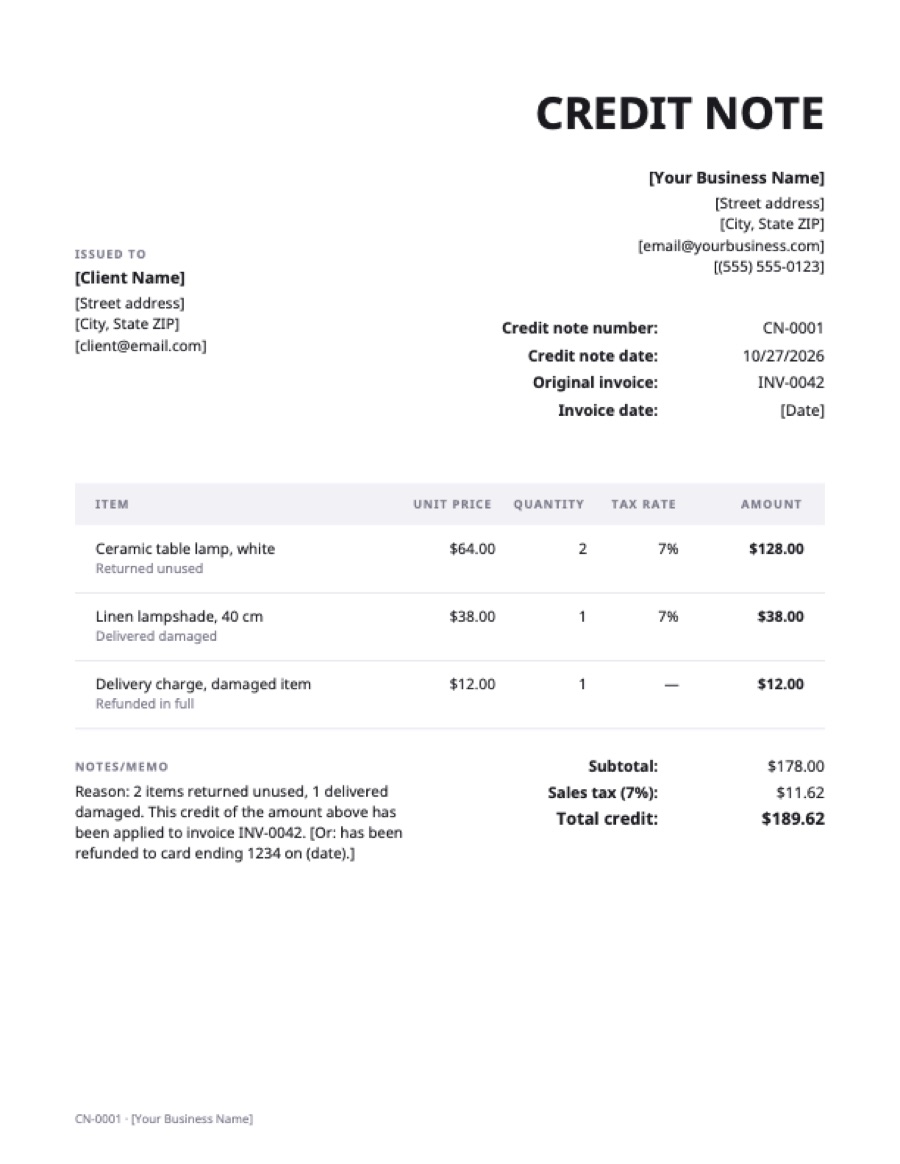
What’s on the credit note template
Extra fields on this template: Original invoice, Invoice date.
| Item | Qty | Rate | Amount |
|---|---|---|---|
| Ceramic table lamp, whiteReturned unused | 2 | $64.00 | $128.00 |
| Linen lampshade, 40 cmDelivered damaged | 1 | $38.00 | $38.00 |
| Delivery charge, damaged itemRefunded in full | 1 | $12.00 | $12.00 |
| Subtotal | $178.00 | ||
| Sales tax (7%) | $11.62 | ||
| Total credit | $189.62 | ||
Example prices in US dollars. Replace them with your own; in the generator, any currency works.
What a credit note must include
- The words “Credit note” (or “Credit memo”) at the top, so nobody mistakes it for an invoice. The template prints them.
- A credit note number from its own sequence, such as CN-0001, and the date it was issued.
- Your business details and the customer’s, as on the original invoice, with tax numbers where your country requires them.
- The original invoice number and date, so the credit can be matched to what it corrects.
- The reason: returned goods, overcharge, cancelled service, damaged delivery.
- What’s credited: each item or service, the quantity and the amount.
- The tax credited, at the rate charged on the original invoice, and the total credit.
- What happens to the money: taken off the unpaid invoice, refunded, or held against the next invoice.
Credit note, credit memo, refund: which is which
| Term | What it means |
|---|---|
| Credit note | The document that reduces an invoice. The usual term in the UK, Europe, India, Australia and most of the world. |
| Credit memo | The same document, under its US name (short for credit memorandum). |
| Refund | Money paid back. A credit note can lead to a refund, but the customer may instead use the credit against what they owe. |
| Debit note | The opposite: it increases what the customer owes, for example after an undercharge. |
Why not just edit the invoice?
Once an invoice is sent, it’s part of both your records and the customer’s. Changing or deleting it leaves a gap in your invoice numbers and a mismatch with the copy the customer holds, which is exactly what tax authorities and auditors look for. A credit note keeps the original intact and records the correction on its own date. Cancelling an invoice in full works the same way: issue a credit note for the whole amount.
Show the amounts as positive numbers under the “Credit note” title, as this template does. Some accounting software prints them as negatives instead; either is fine as long as the document clearly says it is a credit.
Frequently asked questions
What is a credit note?
A document a seller issues to reduce what a customer owes on an invoice already sent, for example after a return, an overcharge or a cancelled order. It quotes the original invoice and shows the amount and tax credited.
Is a credit memo the same as a credit note?
Yes. Credit memo is the usual US term; credit note is used in most other countries. This template works as either: change the title in the generator to Credit memo if you prefer.
Does a credit note need its own number?
Yes. Give credit notes their own sequence, such as CN-0001, CN-0002, and always quote the invoice number they relate to.
Do I have to refund the money?
Not necessarily. If the invoice is unpaid, the credit comes off what the customer owes. If it was paid, you can refund it or, if the customer agrees, apply it to their next invoice. Say which on the credit note.
Should a credit note include tax?
If the original invoice charged sales tax, VAT or GST on the credited items, credit the tax too, at the same rate. That is how the tax you reported on the sale is reduced.