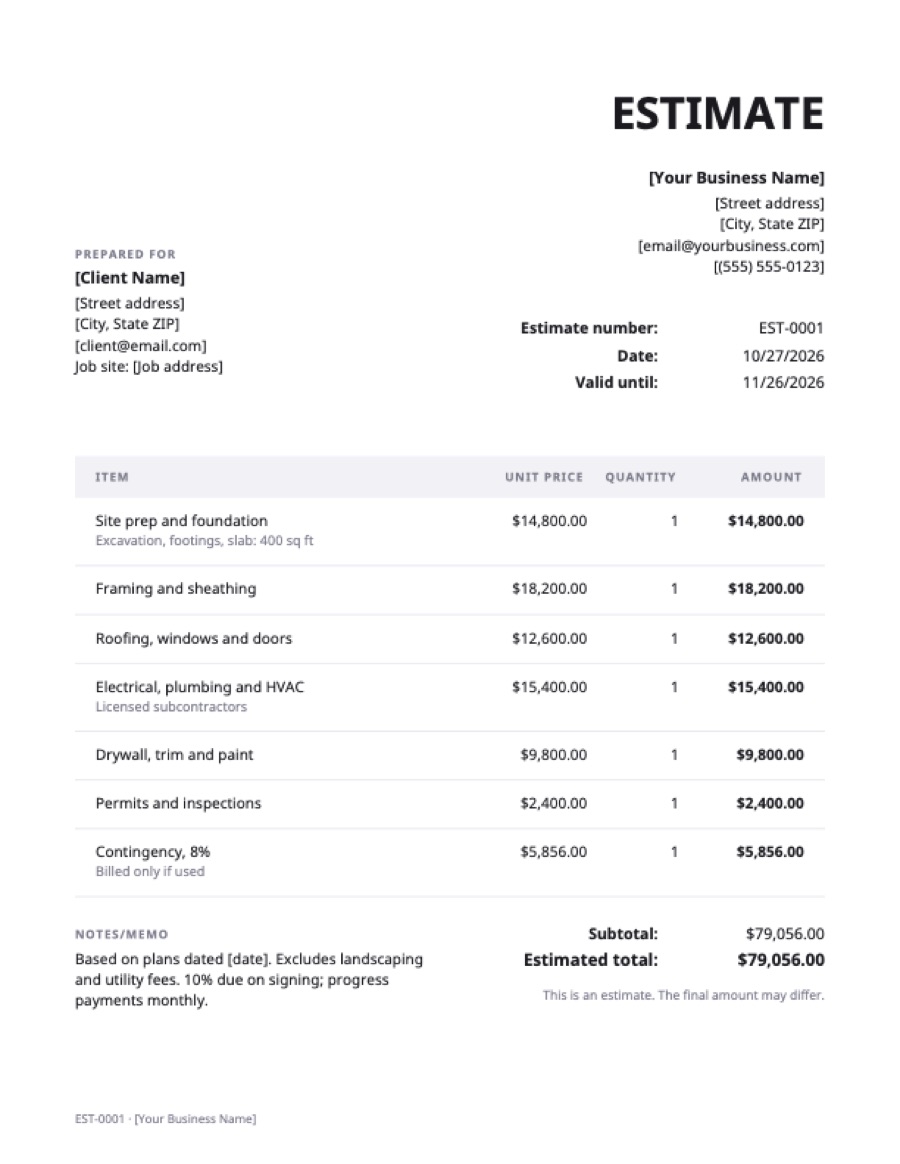
What’s on the construction estimate template
Extra fields on this template: Job site.
| Item | Qty | Rate | Amount |
|---|---|---|---|
| Site prep and foundationExcavation, footings, slab: 400 sq ft | 1 | $14,800.00 | $14,800.00 |
| Framing and sheathing | 1 | $18,200.00 | $18,200.00 |
| Roofing, windows and doors | 1 | $12,600.00 | $12,600.00 |
| Electrical, plumbing and HVACLicensed subcontractors | 1 | $15,400.00 | $15,400.00 |
| Drywall, trim and paint | 1 | $9,800.00 | $9,800.00 |
| Permits and inspections | 1 | $2,400.00 | $2,400.00 |
| Contingency, 8%Billed only if used | 1 | $5,856.00 | $5,856.00 |
| Estimated total | $79,056.00 | ||
Example prices in US dollars. Replace them with your own; in the generator, any currency works.
What a construction estimate should include
- The plans or scope it’s based on, with their date, so everyone prices the same job.
- Costs grouped by phase or trade: site work, foundation, framing, roofing, mechanical, finishes. Lenders and owners compare bids line by line.
- Subcontractor work named as such, with the trade’s license where your state requires it.
- Permits, inspections and fees on their own lines.
- Allowances for anything the owner hasn’t chosen yet, such as fixtures, tile or flooring.
- A contingency, usually 5–10%, for unforeseen conditions.
- Exclusions, the payment schedule and how long the price holds.
Overhead, profit and contingency
Your price has to cover more than labor and materials. Overhead (insurance, vehicles, office, supervision) and profit together typically add 10–20% on residential work. You can build them into each line or show them as a single markup line; either is fine, as long as you’re consistent between bids. Keep the contingency separate and say plainly that it’s billed only if used. Owners accept it more readily when they can see it.
From estimate to progress billing
Once the job is under contract, bill against the same lines. The construction invoice template is set up for progress billing, with the percentage complete for each line, change orders and retainage. Approved changes to the scope should go on a written change order before the work, not on the final bill.
Frequently asked questions
How accurate should a construction estimate be?
A detailed estimate from complete plans is usually within 5–10% of the final cost. An early budget estimate from sketches can be off by 20% or more; label it as a budget figure.
Should I include a contingency?
Yes, for anything involving existing buildings or unknown ground. Show it on its own line and explain that it’s billed only if needed.
Can I turn the estimate into an invoice?
Yes. Open it in the free estimate maker and, when you’re ready to bill, switch the document to Invoice above the preview. The lines carry over.